The Complete Field Guide to Yields, Milling Recovery, and Grain Preservation
Most growers focus entirely on field inputs to increase profits. You buy premium fertilizer, spray targeted crop protection, and optimize irrigation schedules to maximize paddy profitability. Yet, when harvest arrives, up to 15% of your total crop value disappears at the local mill or inside damp storage bins.
Increasing your net farm income requires a full life-cycle approach. You must select the right seed genetics, protect grain integrity during milling, and preserve moisture levels in storage. Here is the operational roadmap to push your recovery past 70% and secure top-tier market returns.
The Recovery Gap: Why 60% Milling Yield Destroys Your Margin
Many growers believe that 1 kg of paddy naturally yields 600 g of rice. This 60% recovery assumption is a costly mistake. Raw paddy consists of roughly 20% inedible husk and 8% to 10% bran. The true biological head and broken rice potential is 70% to 72%.
When a local mill returns only 60% rice, you lose 100 kg to 120 kg of edible rice per ton of paddy. That missing volume turns into pulverized dust and fractured grain inside an uncalibrated machine.
- Low-Tech Village Huller (60% Recovery): A 1,200 kg paddy harvest yields 720 kg rice. At Rs. 230 per kg, your gross rice value is Rs. 165,600.
- Calibrated Rubber-Roll Mill (70% Recovery): The same 1,200 kg paddy harvest yields 840 kg rice, generating Rs. 193,200.
- The Bottom Line: You gain +120 kg of head rice and Rs. 27,600 in cash value simply by changing where and how you mill.
Do not surrender your byproducts. A 1,200 kg harvest produces 80 kg to 100 kg of rice bran (haal kudu). At current market rates of Rs. 70 per kg for animal feed, that byproduct is worth Rs. 7,000. Always contract your miller on a cash-per-kilogram fee and take your bran home.
Modern Processing vs. Village Hullers
Industrial processors achieve 70% to 74% recovery by eliminating thermal and mechanical shock.
- Controlled Drying: Drying paddy directly on open concrete causes rapid moisture loss, thermal stress, and internal cracks. Dry your paddy gradually in shaded, well-ventilated areas, or use recirculating air dryers that drop moisture at a steady 1% per hour.
- Pressurized Parboiling: Open-vat cold soaking leads to sour fermentation and uneven kernel softening. Pressurized steam parboiling gelatinizes grain starch, sealing internal fissures before the paddy hits the huller.
- Pneumatic Rubber Rollers: Single-pass steel hullers crush kernels under heavy friction. Rubber-roller de-huskers strip only the outer fibrous husk and keep the core kernel intact.
- Multi-Stage Polishing: Aggressive single-pass polishers overheat the rice. Use multi-pass vertical abrasive whiteners followed by light water-mist polishing to create a hard, glossy finish without kernel snapping.
The 12% Moisture Rule and Hermetic Storage
Harvesting high yields means nothing if weevils destroy your grain within four months. Protect your harvest using three clear storage rules:
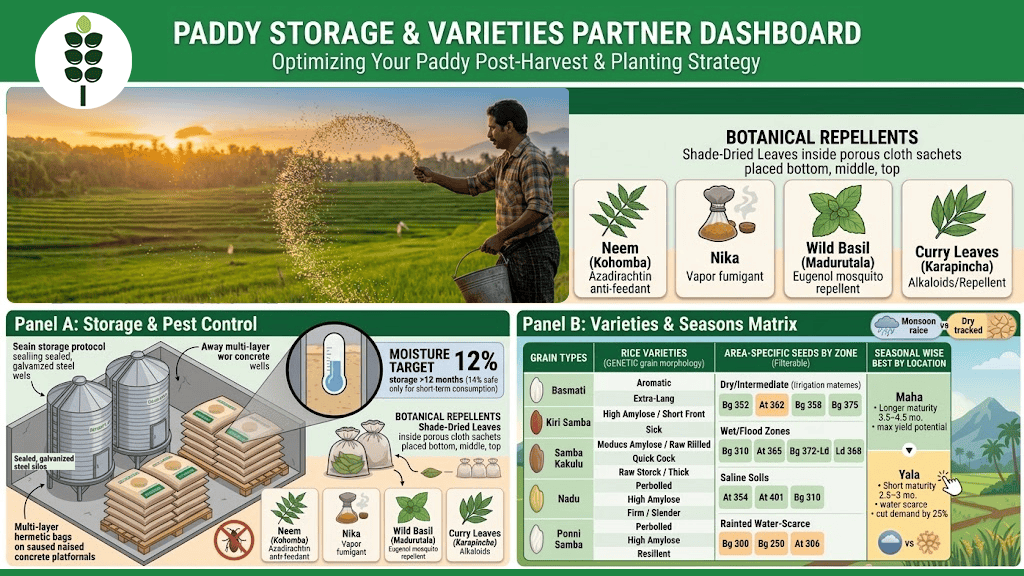
- Drop Moisture to 12%: A 14% moisture level is acceptable for immediate consumption, but long-term storage beyond six months requires 12% to halt fungal growth and internal grain respiration.
- Use Hermetic Bags: Store unhusked paddy inside multi-layer hermetic bags (such as GrainPro). These seal airtight, deplete oxygen, and suffocate insects naturally without toxic chemical fumigation.
- Elevate on Wooden Pallets: Never place grain bags on bare concrete floors or against walls. Concrete transfers ambient moisture and creates localized heat zones that rot grain.
Botanical Pest Defense Pack shade-dried leaves into porous cotton sachets at 2% to 5% grain volume and position them at the bottom, middle, and top of your bins:
- Neem (Kohomba): Contains azadirachtin to disrupt insect feeding and larval development.
- Nika (Vitex negundo): Releases natural terpenes that act as a vapor fumigant in closed storage.
- Wild Basil (Madurutala): Emits high eugenol levels that deter adult moths from laying eggs.
- Curry Leaves (Karapincha): Repels surface grain borers and inhibits mold spore development.
Seed Selection: Matching Variety to Soil and Season
Your seed paddy determines your yield potential, water efficiency, and crop resilience.
- Dry and Intermediate Zones (Irrigated Schemes): Choose Bg 352, Bg 358, Bg 375, or At 362. These varieties have stiff straw, resist lodging, respond aggressively to fertilizer, and yield 6 to 8 metric tons per hectare.
- Low Country Wet Zones (Flood-Prone / Ill-Drained): Plant Bw 367, Bw 272-6b, or Ld 365 for submergence tolerance and resistance to iron toxicity.
- Saline and Coastal Tracts: Use At 354, At 401, or Bg 310 to manage high soil electrical conductivity.
- Seasonal Strategy: In Maha, plant 3.5 to 4.5-month varieties to capture full monsoonal water and build large panicles. In Yala, switch to 2.5 to 3-month varieties like Bg 300, Bg 250, or At 306 to reduce water demand by 25% and harvest before reservoir levels drop.
AgriOne Fertilizer and Seed Company delivers certified high-yield seed paddy, specialized balanced crop nutrition, and post-harvest technical advisory for commercial farms and outgrower networks across Sri Lanka.